

Knee pain is one of the most common problems people face as they age. For some, it’s mild and comes and goes, but for many others, it becomes so severe that even simple things like walking, climbing stairs, or sitting down are painful.
When medicines, exercises, or injections no longer help, total knee replacement surgery can give a new life. Let’s understand what total knee replacement means, who needs it, how it’s done, and how recovery works in simple words.
What is Total Knee Replacement?
Your knee joint connects the thigh bone (femur) and the shin bone (tibia). Between them is a smooth surface made up of cartilage that helps the bones move easily without rubbing. When this cartilage wears out due to arthritis, injury, or age, the bones start grinding against each other. This causes pain, swelling, and stiffness.
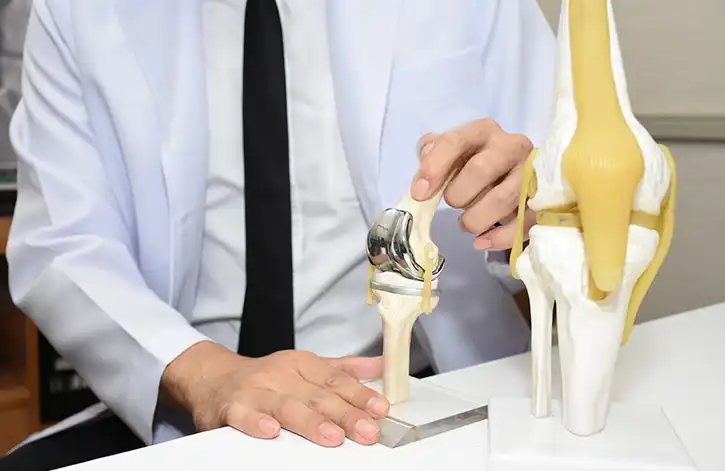
A total knee replacement (TKR) – also called knee arthroplasty – is a surgery in which doctors remove the damaged parts of the knee and replace them with artificial parts (implants) made of metal alloys and ultra weight polymers and sometimes ceramics.
After surgery, the knee moves smoothly again, and most patients can walk, climb stairs, and live without constant pain.
Who Needs a Total Knee Replacement?
Doctors usually suggest knee replacement when:
- Pain is severe and constant, even at rest.
- You find it hard to walk, climb stairs, or stand for long.
- The knee becomes stiff, swollen, or deformed.
- Other treatments like medicines, physiotherapy, or injections no longer help.
Most patients are above 50, but younger people with joint damage from injury or arthritis can also benefit from this surgery.
Common Causes of Knee Damage
Total knee replacement is often needed because of:
- Osteoarthritis: The most common cause, happens with age as the joint cartilage wears down.
- Rheumatoid Arthritis: An autoimmune disease where the body attacks joint lining.
- Post-Traumatic Arthritis: Develops after serious knee injury or fracture.
- Genetic or Structural Problems: In some cases, bone shape or structure increases wear on the knee.
Pre-Surgery Evaluation
Before surgery, doctors perform several tests to make sure you’re ready and healthy for the procedure.
- Physical examination to check knee movement and pain level.
- X-rays or MRI to see how damaged the joint is.
- Blood tests and ECG to check overall health.
- Discussion about medications, allergies, and previous surgeries.
The doctor will also explain what to expect before, during, and after surgery so you can prepare mentally and physically.
How is the Total Knee Replacement Surgery Done?
The surgery usually takes 1 to 2 hours. It’s done under spinal or general anesthesia, so you won’t feel pain. Here’s how it works step by step:
- Incision: The doctor makes a small cut over the knee to reach the joint.
- Removal of Damaged Parts: The worn-out cartilage and bone from the femur and tibia are removed.
- Implant Placement: Artificial parts made up of metal and high-grade polymers and ceramics are fixed to replace the damaged joint surfaces.
- Smooth Movement: The doctor checks the alignment and movement of the new joint before closing the cut.
- Bandaging: The incision is stitched and covered with a sterile dressing.
Modern surgeries are often done using computer or robotic assistance, which improves precision and speeds up recovery.
Benefits of Total Knee Replacement
Most people who undergo TKR notice life-changing improvement:
- Pain relief – no more constant ache.
- Better movement – easy walking and bending.
- Improved sleep – pain-free nights.
- Stronger confidence – return to daily activities and social life.
- Long-lasting results – most implants last 15 to 20 years or even more.
Possible Risks of Total Knee Replacement
Like any surgery, knee replacement has some risks, though they are uncommon:
- Infection around the wound or implant.
- Blood clots in the legs.
- Stiffness or limited motion.
- Implant loosening over many years.
- Nerve or blood vessel injury (very rare).
However, following doctor’s advice and starting movement early helps avoid most of these complications.
Life After Knee Replacement
After full recovery, most patients return to normal life – walking, driving, cycling, and light sports. You can expect to walk comfortably without pain, and also climb stairs more easily. Enjoy family outings and daily chores again.
But remember, avoid high-impact sports like running or jumping. Maintain a healthy weight to protect your new joint. Keep doing regular exercises to stay strong and flexible.


